
Ready to Evolve Your Institution?
Join forward-looking universities exploring how the future of teaching, collaboration, and academic support can live in one platform.
Join forward-looking universities exploring how the future of teaching, collaboration, and academic support can live in one platform.
March 2026 • 6 min read
Creating high-quality question papers is one of the most time-consuming tasks in academia. According to the American Council on Education, professors spend an average of 9-18 hours per week just creating assignments and exams for a single course. That's not grading—that's purely the creation phase.
For educators managing multiple courses or large lecture halls, this time investment becomes unsustainable. The result? Recycled questions, rushed assessments, or burnout. But there's a revolution happening in educational technology that's changing this equation entirely.
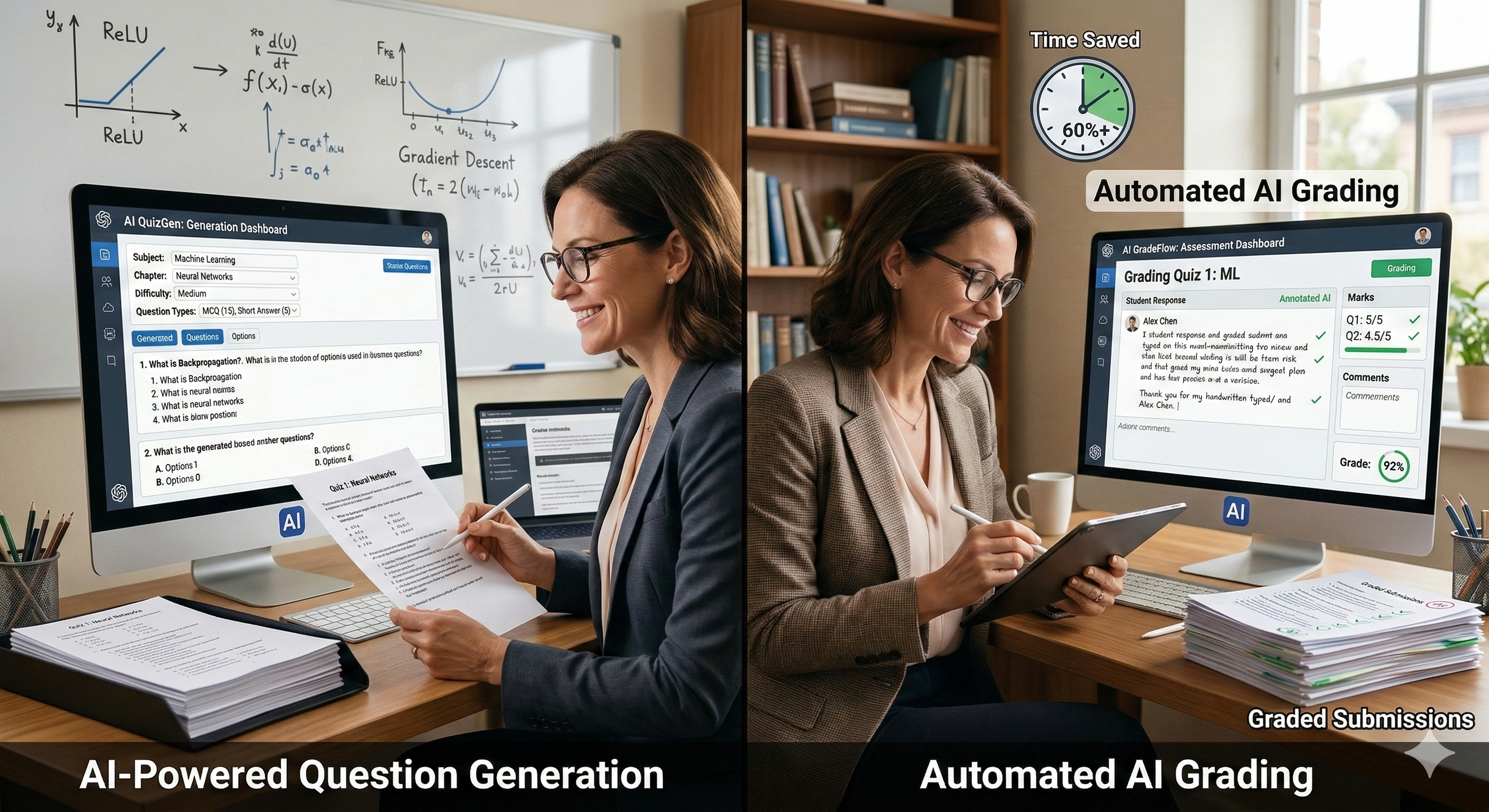
Recent research reveals the transformative impact of AI on educational assessment:
The numbers tell a compelling story of rapid adoption:
Understanding why traditional question paper creation is so time-intensive helps explain why AI makes such a dramatic difference:
Creating quality assessments requires:
Each of these steps consumes hours, especially when you're creating original questions that genuinely assess understanding rather than just recall.
Educators often teach the same courses semester after semester. Yet creating entirely new assessments each time is necessary to prevent academic dishonesty. This means the 9-18 hour investment repeats every single term, often multiple times per term for midterms, finals, quizzes, and assignments.
AI can analyze your lecture notes, textbooks, slides, and previous assessments in seconds. What would take you hours of review happens instantaneously, with the AI identifying:
Modern AI doesn't just generate random questions—it creates contextually appropriate assessments that:
Real-world impact: Vidya AI users report reducing question paper generation from 9 hours to under 1 hour (including revisions and customization).
Every generated question comes with:
This alone saves 3-4 hours per assessment.
AI naturally creates multiple versions of assessments by:
You can generate 5 different versions of the same exam in minutes, each equally rigorous but distinct enough to prevent cheating.
A legitimate concern is whether AI-generated questions maintain the academic rigor of human-created assessments. Research shows promising results:
Automated evaluation systems that provide immediate feedback help reduce test anxiety among students by creating a less stressful assessment environment (NIH Study on Automated Evaluation)
AI can ensure comprehensive coverage of all learning objectives, something that's easy to overlook when manually creating questions under time pressure.
AI tools provide analytics on:
AI can automatically generate alternative formats:
The global AI education market reached $7.57 billion USD in 2025 and is projected to exceed $112 billion USD by 2034 (Programs.com AI Education Statistics). This massive growth reflects both the demand for and proven value of AI in educational settings.
Professors teaching hundreds of students need multiple assessment versions and can't afford 18+ hours per exam creation.
Creating problem sets with proper mathematical notation and multiple solution paths is especially time-consuming—AI handles this complexity automatically.
Teaching 3-4 sections of the same course? Generate consistent yet varied assessments for each section in minutes.
With limited prep time and no TA support, adjuncts benefit enormously from assessment automation.
Creating standardized assessments across multiple instructors becomes feasible when AI handles the heavy lifting.
The process is straightforward:
Most educators report being productive with AI question generation tools within 15-30 minutes of first use.
As AI continues to evolve, we're seeing emerging capabilities:
The OECD Digital Education Outlook 2026 emphasizes that generative AI can support learning when used with purpose—and question paper generation is one of the highest-value use cases.
Students have always had access to test banks and previous exams. AI actually helps educators stay ahead by making it trivial to create unique assessments every semester. Plus, combining AI-generated questions with proctoring, randomization, and application-focused problems minimizes cheating opportunities.
The opposite is true. By reclaiming 9+ hours per week previously spent on mechanical question creation, you can invest that time in high-impact activities: one-on-one student mentoring, curriculum innovation, research, or simply achieving better work-life balance.
AI question generators like Vidya AI are designed to work with academic standards, not against them. You maintain full control over content, difficulty, and appropriateness. The AI is a tool that amplifies your expertise, not a replacement for it.
Creating quality question papers is essential but doesn't need to consume 9-18 hours of your week. With 73% time reduction demonstrated in research, 92% of students already using AI tools, and 69% of teachers reporting improved teaching methods, the evidence is clear:
AI-powered question paper generation isn't the future—it's the present. Educators who adopt these tools are reporting better work-life balance, higher-quality assessments, and more time for what matters most: teaching and mentoring students.
The question isn't whether to use AI for question generation. It's whether you can afford not to.
Ready to reclaim your time? Try Vidya AI's question generation tool and create your first AI-powered assessment in under an hour—including revisions.